
THE SHORT VERSION
What you’ll take away.
- Study a location together with the processes that make it relevant.
- Use blank maps to check recall rather than only looking at labelled maps.
- Explain a physical process step by step before compressing it into notes.
- The older linked PDF has not been revalidated for contents or edition.
- Keep a clear record of the questions and locations you confuse.
When you study World Geography, a map and an explanation should support each other. Knowing where a mountain range lies is useful; understanding how relief can influence rainfall helps you reason through a question.
Use your notes to connect location, process, and consequence. You can then revise the relationship instead of memorising several disconnected lists.
Choose a reliable starting resource
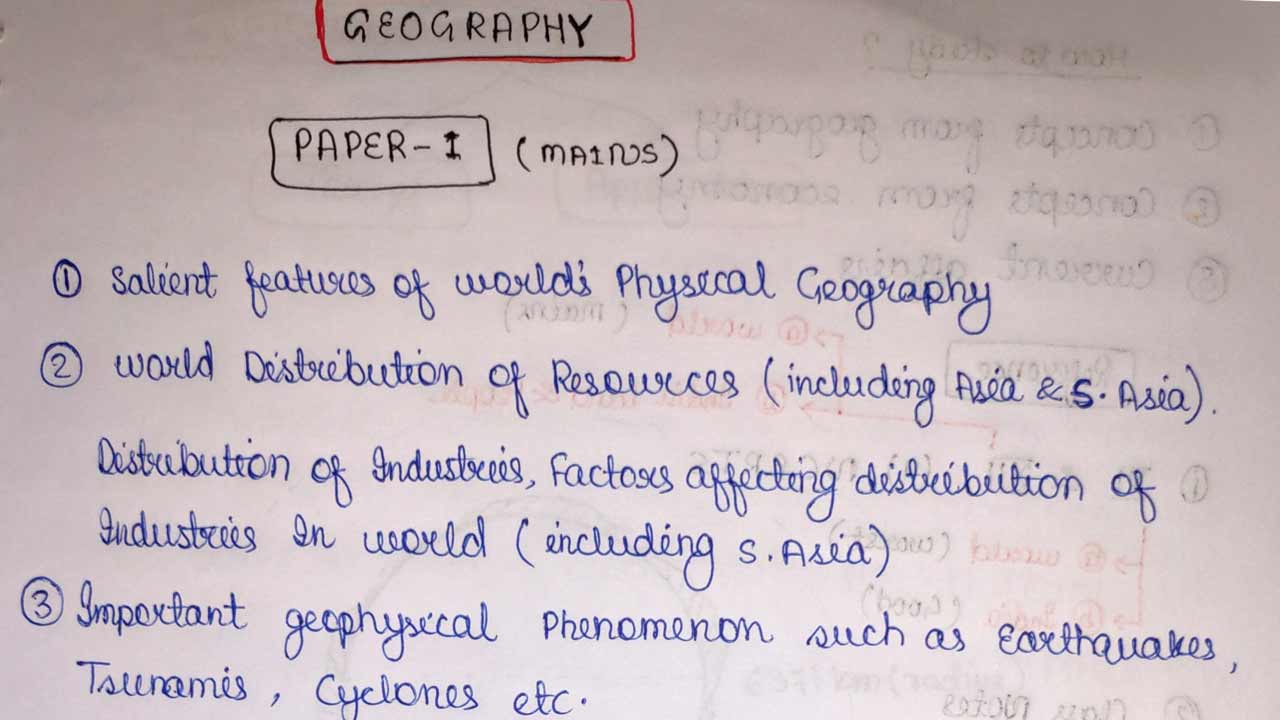
The earlier article offered this World Geography handwritten PDF. Its contents, edition, and current availability have not been revalidated. Check its first pages before relying on descriptions such as “complete coverage” or “updated for this year’s exam.”
For basic concepts, choose Geography textbooks through the official NCERT catalogue. Use an atlas alongside them. The plan below is our suggested study method, not a verified contents list for the older PDF.
Connect four kinds of study
| Study task | What you should be able to do afterwards |
|---|---|
| Physical processes | Explain a sequence, such as air rising and cooling |
| Locations | Place the relevant region on a map |
| Human activity | Explain a connection with settlement, resources, or transport |
| Current developments | Understand why a location or process appears in the news |
Begin with a manageable region or topic. If you read about a strait, locate the connected water bodies and surrounding land. If you read about a climate pattern, identify the processes involved before memorising its distribution.
Work through a rainfall explanation
Consider a simplified situation in which moist air moves toward a mountain. As air rises along the slope, it expands and cools. If it cools sufficiently, water vapour can condense and precipitation may occur.
Air descending on the other side warms, which can contribute to drier conditions on the leeward side. The actual pattern depends on moisture, wind, relief, and other conditions; a mountain does not make every leeward place permanently dry.
For your note, draw a ridge, show the wind direction, and label rising and descending air. Then explain the sequence without looking at the paragraph.
Make map practice active
Look at a small set of locations, close the atlas, and mark them on a blank map. Check immediately and record what caused an error.
“Forgot the name” and “placed it on the wrong side of a sea” are different problems. The first may need recall practice; the second needs you to understand spatial relationships.
If you prefer Hindi explanations, use the Hindi Geography study guide.
Practice question: use the process
Original practice question: In the simplified mountain example, why might rainfall be greater on the windward slope?
Answer: Moist air is forced upward, cools as it rises, and may reach conditions for condensation and precipitation. The explanation depends on the air being sufficiently moist. Simply saying “because there is a mountain” misses the process.
A useful extension is to ask what would happen if the incoming air were very dry. This checks whether you understood the condition rather than memorised the diagram.
Review maps and concepts together
At the end of the week, redraw one process and locate a few places without help. Then attempt a relevant past-paper question and read its wording carefully.
Use the Prelims resource plan to fit Geography beside your other subjects. For the textbook sequence, see the NCERT reading guide. Keep the next step small enough that you can complete it and check what you learned.
Sources and information checks
Source information checked: . For a new application or exam cycle, also read the applicable official notice.
- NCERT: official Geography and other textbooks
- UPSC: previous-year question papers
- NCERT Our Environment: Air, weather, climate and rainfall
This article was prepared or revised with AI assistance. Read our editorial policy.
JOIN THE CONVERSATION
Comments
Have a question or something to add? Comments are moderated and appear here only after approval.
JavaScript is required to submit a comment. Published comments above remain available to read.
No approved comments yet. Be the first to join the conversation.