
THE SHORT VERSION
What you’ll take away.
- Build basic concepts before collecting reports and current figures.
- Keep a statistic's year, unit, and source beside it.
- A fall in the inflation rate can still mean that prices are rising.
- Use dated official sources when adding current policy or economic data.
- Check the source and edition of an older PDF before relying on it.
Economy questions are easier to work through when you can explain the relationship between the terms. Reading that inflation has fallen is different from reading that prices have fallen. Knowing the distinction matters more than memorising a sentence without its meaning.
Use your notes to connect a concept, a small example, and a question. Keep changing figures in a separate section so that an old statistic does not become part of your permanent understanding.
Find the resource you need
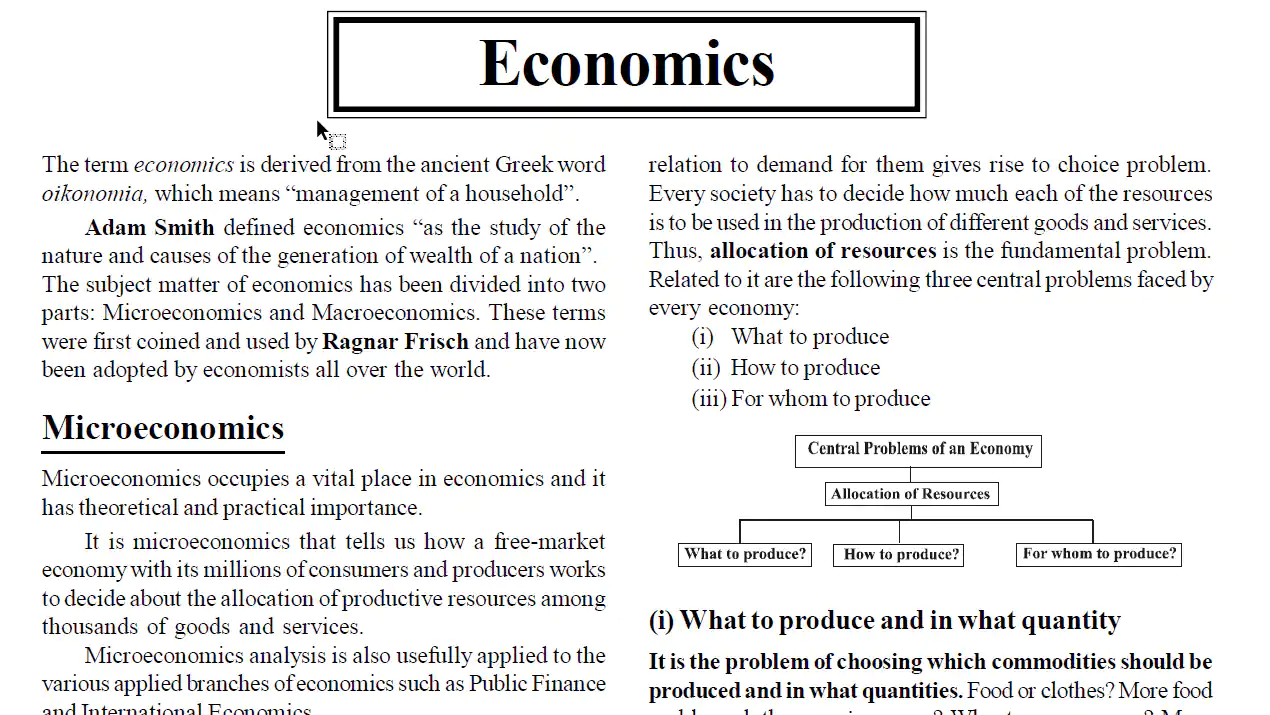
The earlier page linked to this Economy notes PDF. Its contents, edition, and present availability have not been revalidated. Check its title page and topic list before relying on it.
For a reliable starting point, use economics books available through the official NCERT catalogue. For a Budget or Economic Survey reference, open the relevant year’s documents on the official Union Budget website.
The study sequence below is our suggested approach, not a claim about what the older PDF contains.
Read in a sequence that makes sense
Begin with output and income, prices, money and banking, public finance, and the external sector. Move between related ideas instead of treating each definition as a separate fact.
| When you study | Ask yourself |
|---|---|
| Output and income | What is being measured, over which period, and at which prices? |
| Inflation | Which price measure is used, and is the change monthly or yearly? |
| Banking and money | Who is acting, through which instrument, and with what intended effect? |
| Public finance | Is this revenue, expenditure, borrowing, or a transfer? |
| External sector | Is the figure a flow over time or a stock at a particular date? |
You do not need to master every debate in your first reading. Aim to explain the basic distinction, then return when a question or current development reveals a gap.
Work through an inflation example
Suppose an imaginary basket of goods costs ₹100 in Year 1, ₹110 in Year 2, and ₹115.50 in Year 3. These are illustrative numbers.
The rise from ₹100 to ₹110 is 10%. The rise from ₹110 to ₹115.50 is 5%. The rate of increase has fallen, but the basket still costs more in Year 3.
Your note can therefore say: slower positive inflation means prices are increasing more slowly; it does not by itself mean prices are falling. Keep the example beside the distinction so you can rebuild the reasoning later.
Use current data carefully
When you record a figure, include the period, unit, source, and whether it is an estimate or a later revision. “Growth is 6%” is incomplete without the measure and time period.
Separate a proposal, a recommendation, and an implemented measure. For public finance, our Finance Commission explainer shows how to distinguish a recommendation from the documents describing the government’s response.
Practice question: interpret the direction
Original practice question: In the example above, which statement is correct?
- A. The basket becomes cheaper in Year 3.
- B. The basket becomes more expensive, but at a slower rate.
- C. A lower inflation rate means there is no price change.
- D. The two percentages use the same starting price.
Answer: B. The price rises from ₹110 to ₹115.50. The second percentage uses ₹110 as its base, which also explains why D is incorrect.
If you chose A, write “rate of change versus level” in your error notebook. That tells you exactly what to revise.
Review the idea before the statistic
At the end of a chapter, explain its key terms without opening your notes. Then interpret a small table or attempt a related question.
Use our NCERT reading guide if you need to strengthen the basics. When you are ready to write an explanation with causes and consequences, try the Mains answer-writing exercise.
Sources and information checks
Source information checked: . For a new application or exam cycle, also read the applicable official notice.
- NCERT: official textbook catalogue
- Union Budget and Economic Survey documents
- Finance Commission: official reports
This article was prepared or revised with AI assistance. Read our editorial policy.
JOIN THE CONVERSATION
Comments
Have a question or something to add? Comments are moderated and appear here only after approval.
JavaScript is required to submit a comment. Published comments above remain available to read.
No approved comments yet. Be the first to join the conversation.